
A dentistry practice can bring in a lot of money, but the owner’s retirement savings always depend on how well they manage their money. Practice overhead, personnel salaries, equipment costs and debt servicing all impact how much the owner may contribute toward retirement.
A well-structured 401(k) plan may help dentists develop retirement savings, limit tax exposure, and offer meaningful benefits to employees. The optimal structure relies on practice ownership, staff demographics, cash flow, and retirement plans.
In this article, we’ll look at dental practice 401(k) plan options, ways to contribute, plan expenses, compliance issues, and how retirement planning fits into overall wealth management for dentists.
Why 401(k) Planning Matters for Dental Practices
Retirement planning for practice owners must consider both their personal wealth and business equity. A 401k may give tax-advantaged retirement savings beyond the value of the dental practice.
• Build Retirement Assets Outside of Practice Equity
Practice can be a major part of a dentist’s net worth. Retirement funds and personal investments can help diversify that wealth and give assets outside the business when the owner retires or sells the practice.
• Processing Practice Cash Flow Contributions
Employer contributions impact payroll costs and cash flow operations. Dentists require a plan that factors in the costs of labor, equipment financing and other practice expenses while supporting their retirement aspirations.
• Make Employee Benefits Work for Your Practice
A 401(k) may be included in the practice’s employee benefits package. Employer matching or profit-sharing contributions can be a tool to recruit and retain dental hygienists, assistants, and administrative personnel.
• Combine Retirement Contributions with Tax Planning
A practice owner’s contribution strategy should consider eligible employee deferrals, employer contributions, compensation, and other retirement plans. The correct structure may also impact the owner’s ability to access other tax-advantaged retirement options.
A good strategy ties together retirement savings, employee perks and practice finances without putting undue burden on the firm.
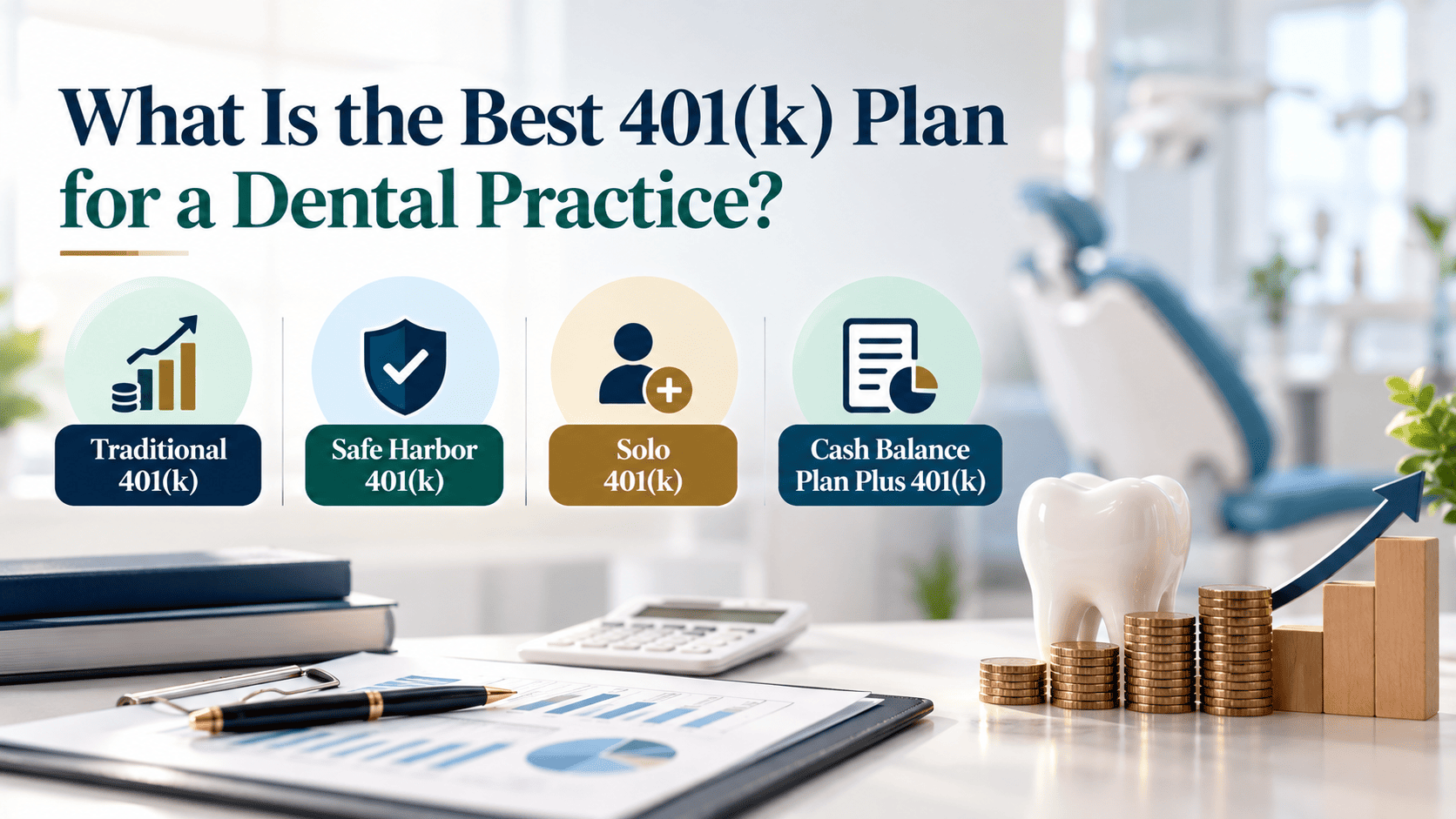
What Is the Best 401(k) Plan for a Dental Practice?
The correct 401(k) plan design depends on the number of employees in the practice, ownership, payroll, and retirement contribution objectives. The dentist should evaluate the saving capacity of the owner and cost and compliance criteria of the plan.
Traditional 401(k)
A standard 401(k) allows eligible employees to defer some of their salary into retirement savings. The employer may also make matching contributions or profit-sharing payments. This structure can be appropriate for companies that want a formal retirement benefit for the team and aid in growing owner retirement assets.
Safe Harbor 401(k)
A Safe Harbor 401(k) includes certain employer contributions and can help a practice meet some nondiscrimination testing standards. This approach may be suitable for owners who desire to maximize their contributions, within the plan rules and applicable limits, while delivering a specific benefit to eligible employees.
Solo 401(k)
A solo 401(k) can be a good fit for a dentist who owns a practice and has no eligible employees other than a spouse. The owner can contribute both as an employee and an employer within IRS restrictions and eligibility requirements. Once the practice has eligible staff employed, then the owner must examine if the plan is still eligible.
Cash Balance Plan Plus 401(k)
A cash balance plan is a defined benefit plan, not a 401(k)-style plan. Eligible practices can combine this with a 401(k) to contribute more to tax-deferred retirement savings. The number of contributions will vary on the age, level of pay, design of the plan, and actuarial calculations. It also sets forth ongoing financing and administrative requirements.
The optimum approach is to model owner contributions, employee costs, tax benefits, and long-term financial commitments before picking a plan.
How Can Dentists Optimize Their 401(k) Plan?
Optimizing a 401(k) for a dental practice owner boil down to owner contribution capability, employer financing duties, plan testing and the tax treatment of retirement contributions. The plan needs to be based on the profit margins of the practice, personnel demographics, and the owner’s retirement timetable.
1. Contributions of Model Owner vs. Employee Costs
A dentist’s contribution capability is determined by age, qualified compensation, employee deferrals, employer contributions, and annual limits on IRS contributions. Owner contribution limits can also be affected by employee demographics and plan design.
Practical application: Have your third-party administrator (TPA) conduct a contribution analysis based on your practice’s employee population and estimated compensation. Before you choose a contribution formula, compare the maximum contribution of the owner with the required employer funding and total plan cost.
2. Review Employee Eligibility and Nondiscrimination Testing
A practice with highly compensated owners and lower-paid staff may be subject to limits under Actual Deferral Percentage (ADP) and Actual Contribution Percentage (ACP) tests unless the plan qualifies for an applicable exception, such as Safe Harbor treatment. Eligibility regulations also affect which employees get in the plan and when.
Practical application: Ask your TPA to predict the impact of staff turnover, eligibility of part-time employees, changes in salary, and participation rates. This might help you determine whether a standard 401(k), Safe Harbor design or other plan structure is appropriate for the practice.
3. Designing Profit-Sharing Around Practice Cash Flow
The practice has the flexibility to make a discretionary profit-sharing contribution, as permitted by the plan document and applicable allocation regulations. However, the contribution formula can impact the owner’s share compared to employee allocations.
Practical application: Discuss pro-rata and authorized cross-tested allocation strategies with your TPA. Look at the resulting employer cost by employee group. Test the method against predicted practice profit after payroll, equipment finance, and other operational expenses.
4. Testing the Economics of a Cash Balance Plan
A cash balance plan can support larger tax-deferred contributions for some practice owners, particularly those with high, stable income and a long-term funding horizon. Plan requires actuarial calculations and could lead to large contribution obligations for eligible employees.
Practical application: Ask the TPA and the actuary for a combined 401(k) and cash balance plan depiction. Compare the planned contribution of the owner, employee financing, deductible employer contributions, administrative fees, and minimum funding needs to the predicted cash flow of the practice.
5. Audit Fees, Investments and Plan Administration Fees
Plan costs can include TPA fees, recordkeeping, investment expenses, advisory fees, and, when relevant, audit costs. The investment lineup demands attention too, because fund fee ratios and participant asset allocation can affect retirement outcomes.
Practical application: Review the plan’s fee disclosures, investment expense ratios, participation data, and yearly testing results. Make that the plan administrator meets necessary filing deadlines, and the practice satisfies its fiduciary responsibilities.
Dental practice 401(k) planning is centered on crafting owner contributions and employee benefits in line with the practice’s actual financial capability, with exact forecasts for tax deductions, compliance costs, and long-term retirement funds.
Common 401(k) Planning Mistakes Dentists Should Avoid
A dental practice 401(k) can be a great way to accumulate retirement savings over the long haul, but the wrong kind of plan structure might raise fees or limit how much the owner can put in.
• Selecting a Plan Without Employee Demographics Review
Impact of employee age, pay, tenure and involvement on contribution allocations and nondiscrimination testing. Review these details before choosing a plan structure that works for your practice.
• Ignoring the Compliance Requirements
401(k) Plans Have IRS and ERISA Requirements that need regular attention, including nondiscrimination testing, employee eligibility, contribution limits, vesting regulations, and annual reporting. A third-party administrator can help with these obligations and help keep the plan running smoothly.
• Analysis Excludes Fees or Investment Expenses
Recordkeeping, investment management, advising, and administrative costs can all eat away at retirement savings over time. Review the plan’s fee disclosures and investment alternatives annually to evaluate what you’re paying for and where expenditures could be trimmed.
• Making Contributions the Practice Cannot Afford
Cash balance plans, employer matching, and profit sharing can be quite expensive to maintain on an ongoing basis. Review your practice’s financial flow and anticipated expenses before establishing a contribution formula. This is especially true when revenue is unpredictable, or staffing costs are constantly rising.
How 401(k) Planning Fits Into Wealth Management for Dentists
Practice 401(k) is part of a dentist’s whole financial plan. Its contribution structure should be consistent with cash flow from operations, personal investments, debt commitments, and retirement objectives.
For example, a dentist planning to sell the practice may want to accumulate retirement funds outside the practice. Project retirement income by integrating the 401(k), taxable investment portfolio and predicted practice sale revenues.
This is the point where dentists’ financial planning and practice-level decisions meet wealth management. A good approach can help you address retirement contributions, tax exposure, portfolio diversification and the liquidity you will require pre- and post-sale of your practice.
How BNG Wealth Advisors Helps Dentists With Retirement Planning
A well-designed 401(k) can help dentists establish retirement funds outside of their business and provide significant benefits for workers. The right plan relies on owner contribution goals, employee demographics, compliance rules, and available cash flow.
Integrating dental practice 401(k) planning into a broader wealth management context allows you to tie retirement savings into tax planning, investment management, and the eventual transfer out of practice ownership.
BNG Wealth Advisors helps dentists with retirement planning, investment management, tax-efficient techniques, and practice-related financial decisions as part of a complete wealth management plan.
Contact BNG Wealth Advisors to discuss how your practice retirement plan can help you achieve your long-term financial objectives.
FAQs
What is the best 401(k) for a dental practice?
The optimal plan depends on the size of your business, your staff, how much you make, and your retirement aspirations. If you have employees, a standard or Safe Harbor 401(k) can be a good choice. If you are a sole proprietor running a qualified practice with no workers other than yourself and your spouse, you may be eligible for a Solo 401(k). Established practices wishing to save more for retirement may want to consider a cash balance plan as well.
How much may a dentist contribute to a 401k?
Your contribution limits are based on the tax year, your age, compensation, and how your plan is set up. Employer contributions are also counted in aggregate toward the appropriate limits. Review the current IRS restrictions, including your personal donations and any contributions made by your practice.
Can a dental practice owner combine a 401(k) and cash balance plan?
Yes. Practice owners who qualify can combine the two programs to add more money to retirement on a tax-deferred basis. Before you set up, an actuary should assess your ability to contribute, the cost of covering your eligible employees and the funding commitments.
Are your 401k contributions deductible if you own a dental practice?
Traditional 401(k) contributions usually lower your current federal taxable income, subject to applicable rules. Your clinic may also be allowed to deduct qualified employer contributions. Roth contributions function a little differently since they’re made with after-tax cash, so it’s important to get the contribution type right.
Can a dental practice offer a 401(k) to employees?
Yes. Depending on the rules of your plan, you can offer a 401(k) to qualifying employees. But you will have to meet applicable eligibility and contribution requirements, your fiduciary responsibilities and mandatory reporting. A third-party administrator can assist with paperwork and ensure the plan remains compliant.
How does a 401(k) fit into dental wealth management?
Your practice may represent a large portion of your wealth, but it should not be your primary retirement asset. A 401(k) is one way to save outside the business. You can combine it with tax planning, personal investments, debt reduction and any earnings you may receive from selling your firm for a more complete retirement plan.